
Upcoming Events:
3-Community Joint-Public Forum
Date: Wednesday October 21, 2026 Time: 7-9 PM Location: Hartford Town Hall
Members of each community are welcome to attend any or all RSU Withdrawal Public Hearings
Links:
- Why We’re Here
- 1. How Did We Get Here?
- 2. The Process
- 3. What Would the Proposed District Look Like?
- 4. What Happens to Students and Programs?
- 5. What Would It Cost to Operate the New District?
- 6. What Is a Transition Budget?
- 7. How Could Withdrawal Affect Local Taxpayers?
- 8. What Are BHS Communities Paying Today?
- 9. What Has Happened to RSU 10’s Budget?
- 10. What Can We Learn From Other Maine Communities?
- 11. What Do These Comparisons Actually Tell Us?
- 12. Where Could Future Savings Come From?
- 13. Educational Service Centers
- 14. The New Maine DOE Funding Formula
- 15. What Would Local Control Actually Mean?
- 16. Misconceptions / Misinformation
- 17. The Decision Before Voters
- 18. Whats Next?
- Committee Links
Why we’re here:
On November 3, 2026, residents of Buckfield, Hartford, and Sumner will vote in a referendum on whether our three communities should withdraw from RSU 10 and form a new BHS Regional School Unit, or remain part of RSU 10.
This page was created to share the information, research, financial analysis, planning documents, and comparisons assembled throughout this process so residents can review the work for themselves and make an informed decision.
The committee’s responsibility has been to examine the feasibility of withdrawal, develop the required plans and agreements, understand the financial and educational implications, and provide the public with the most complete information available.
Referendum: November 3, 2026
1. How Did We Get Here?
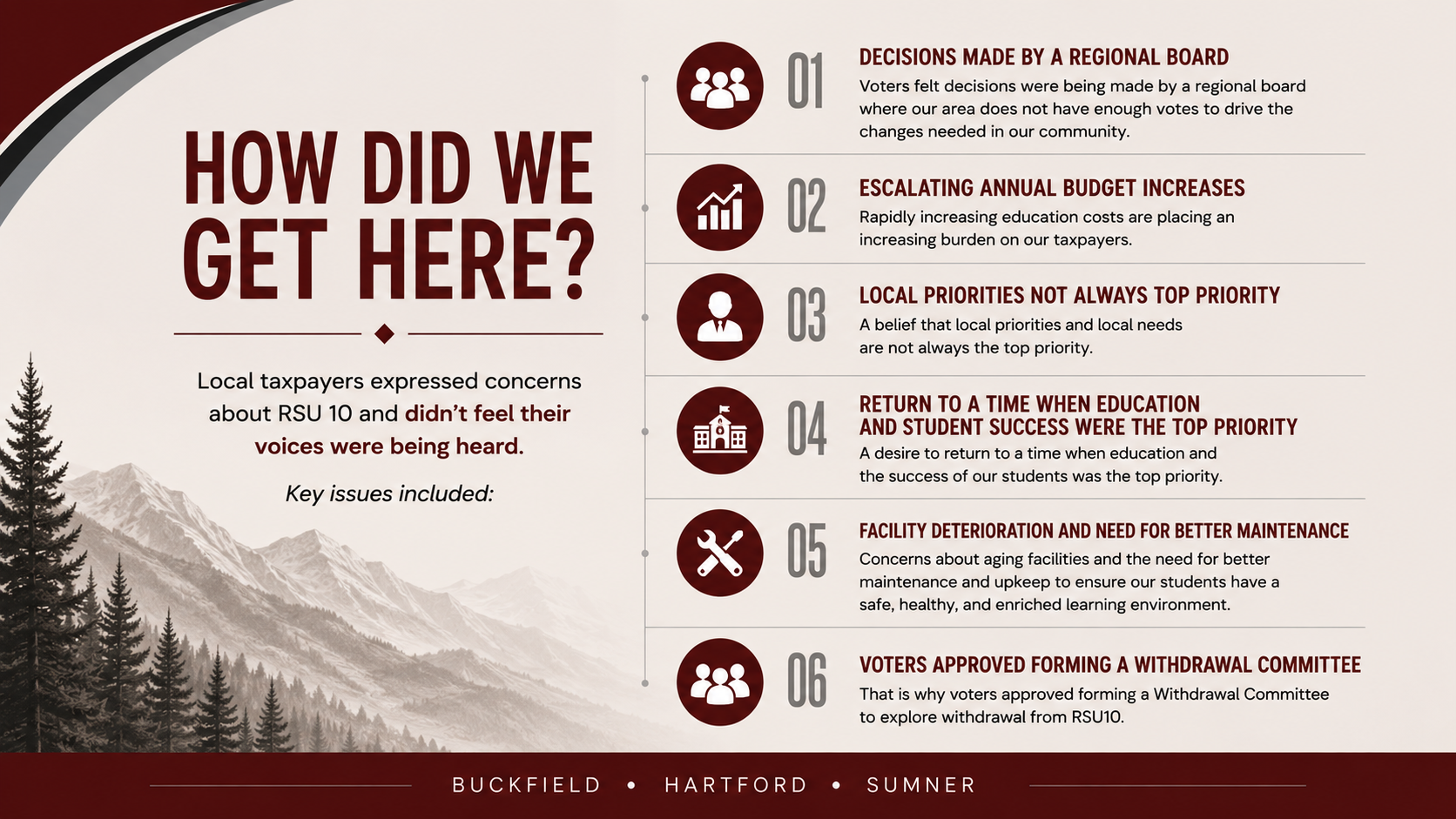
In November 2025, voters in Buckfield, Hartford, and Sumner authorized the communities to explore withdrawal from RSU 10. That vote did not approve withdrawal. It began a formal process to determine whether forming a new regional school district was feasible and what that district could look like.
Since then, the committee has worked with legal counsel, educational consultants, RSU 10, the Maine Department of Education, municipal officials, and community representatives to develop the agreements, budgets, governance structure, and transition framework necessary for voters to make the final decision.
2. The Process:
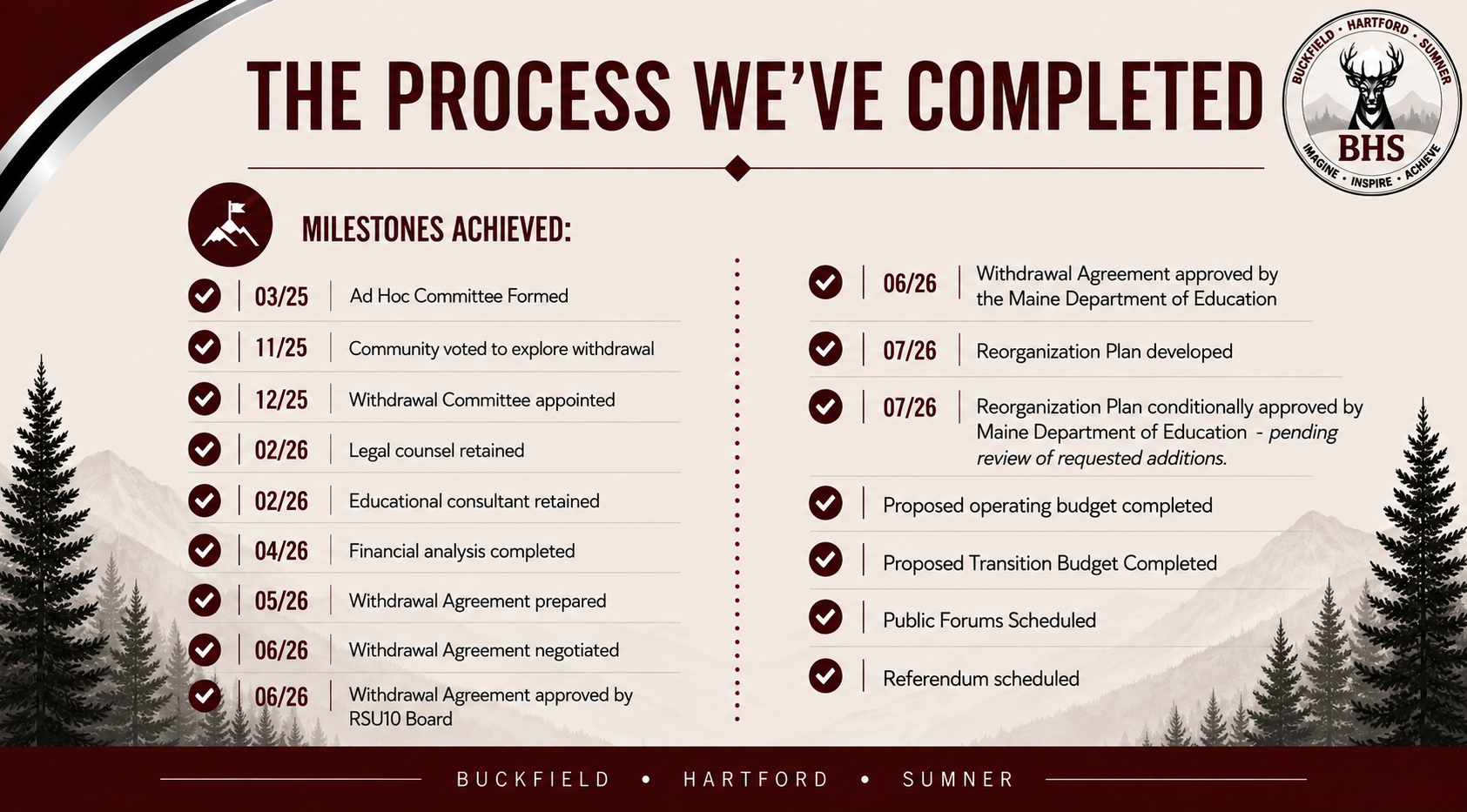
Where the process stands today:
The Withdrawal Agreement has been negotiated and approved by the RSU 10 Board and the Maine Department of Education. The Reorganization Plan has been approved by the Maine Department of Education. A proposed operating budget and transition budget have also been developed.
The final decision belongs to the voters of Buckfield, Hartford, and Sumner.
3. What Would the Proposed BHS RSU Look Like?
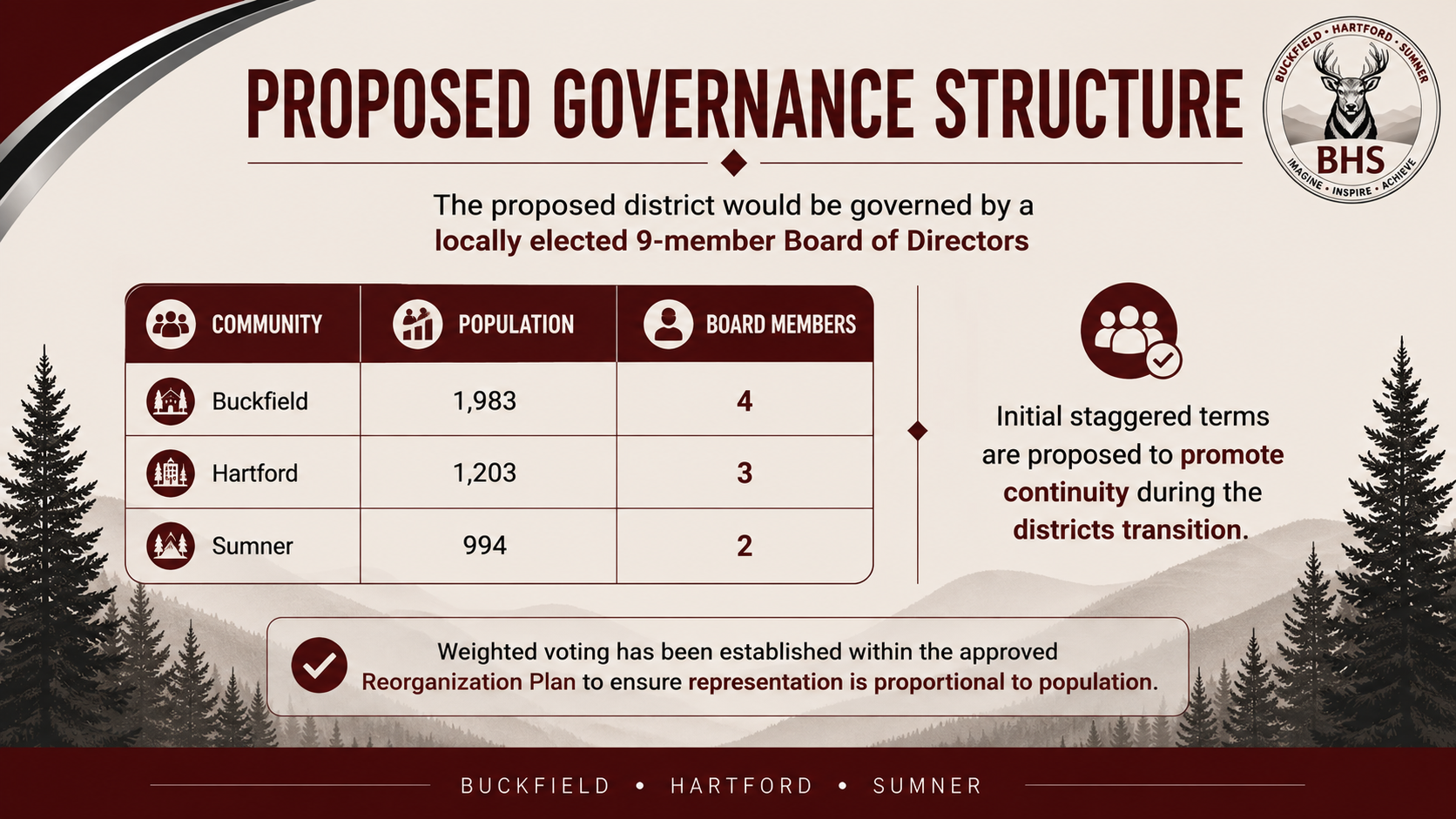
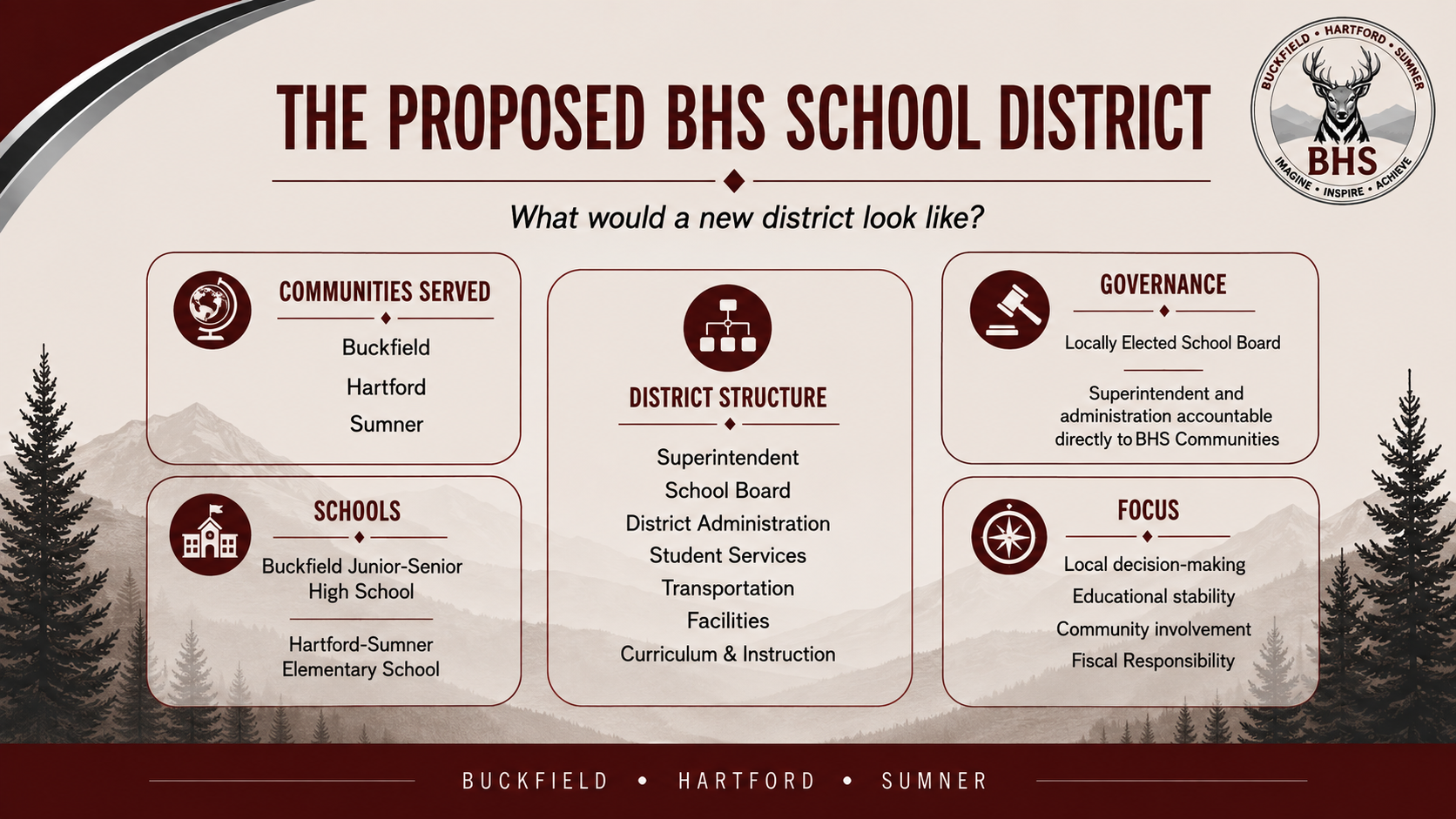
The proposed district would include Buckfield, Hartford, and Sumner, operating the schools currently serving these communities under a locally governed regional school unit.
The planning process has focused on creating a framework for a smooth transition to a new BHS RSU on July 1, 2027, while maintaining the programs, staffing, student services, extracurricular activities, transportation, facilities, and other services our schools rely on today.
4. What Happens to Students and Programs?
Students Come First
The proposed operating budget was built around maintaining the existing current student experience.
The framework developed by the committee was intentionally built around continuity, stability, and maintaining educational quality during the transition.
Our proposed budget fully funds current staff and student-facing academics, with extra-cuurricular programming remaining in place.
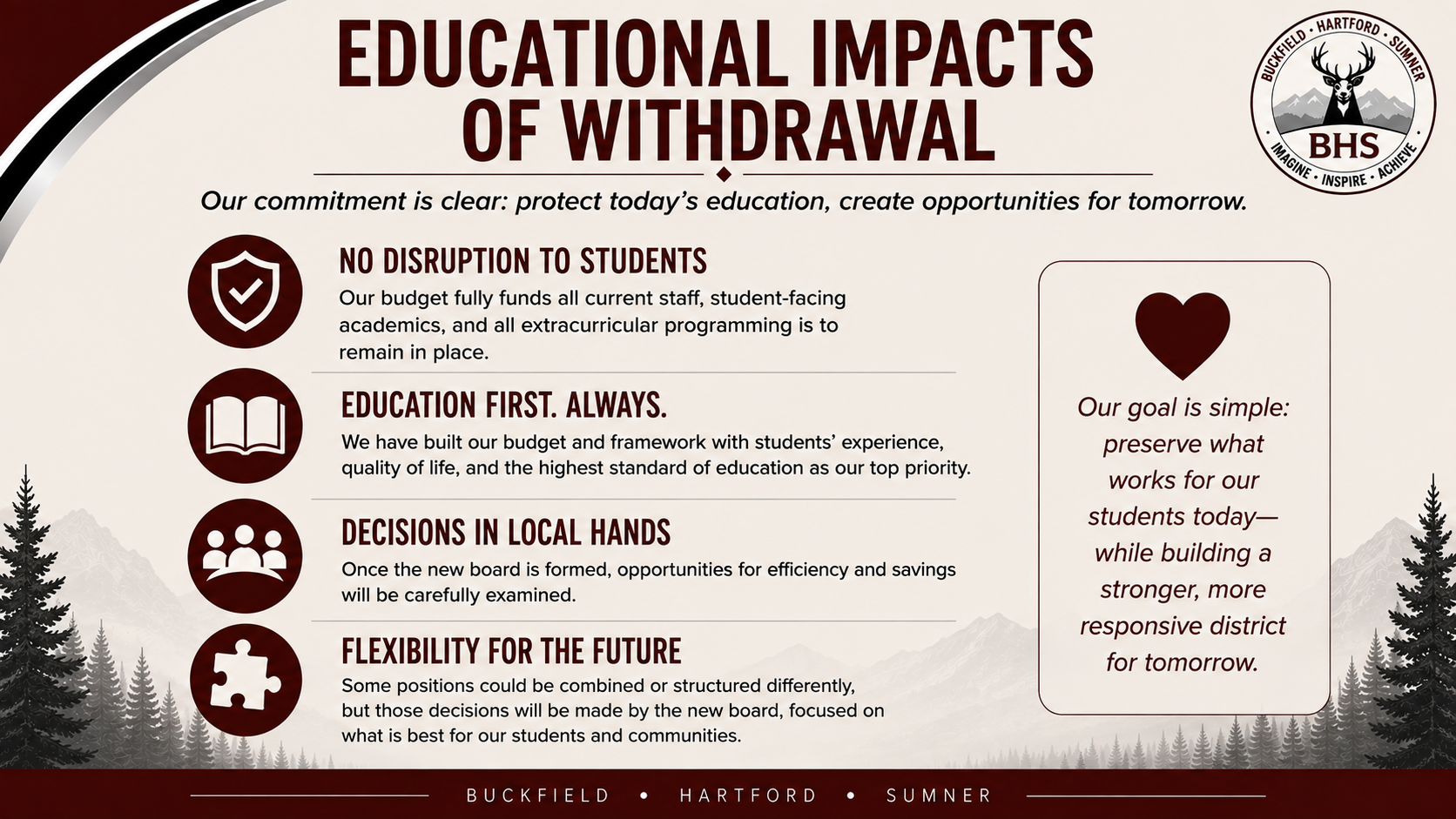
Once a new BHS School Board is elected and the district begins operating, that board would be responsible for future educational, staffing, program, and budget decisions. Opportunities for efficiencies may exist - including the possibility of combining certain administrative responsibilities - but those decisions would belong to the future board.
5. What Would It Cost to Operate the New District?
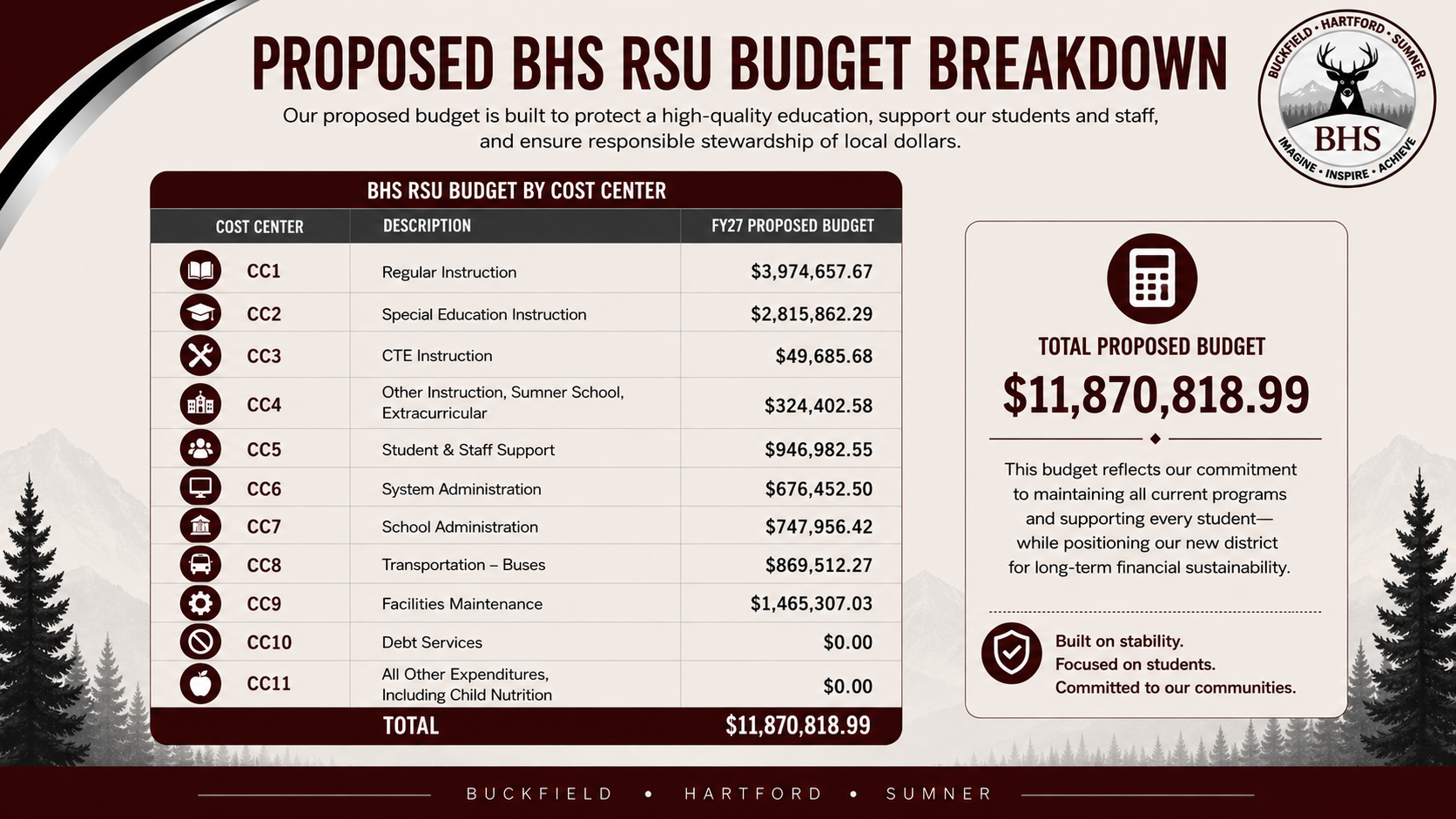
Proposed BHS RSU Operating Budget
The proposed budget includes regular instruction, special education, student and staff support, administration, transportation, facilities and maintenance, extracurricular programming, technology, and the other services necessary to operate the district.
Total proposed operating budget: $11,870,818.99
BHS Would stand to received $420,000 in carryover funds from RSU 10 as well as approximately $30,000 for revenue from the nutrition fund.
The objective is not to suggest that costs will stop increasing. The objective is to determine whether greater local control can help manage and potentially slow the rate of future cost growth.
The budget was developed as a starting operating framework, not as a promise that future budgets will remain unchanged. Like every school district, BHS would continue to face inflation, wages, energy costs, special education expenses, transportation costs, facilities needs, and other factors that can increase education spending.
6. What Is a Transition Budget?
Building the Bridge to July 1, 2027
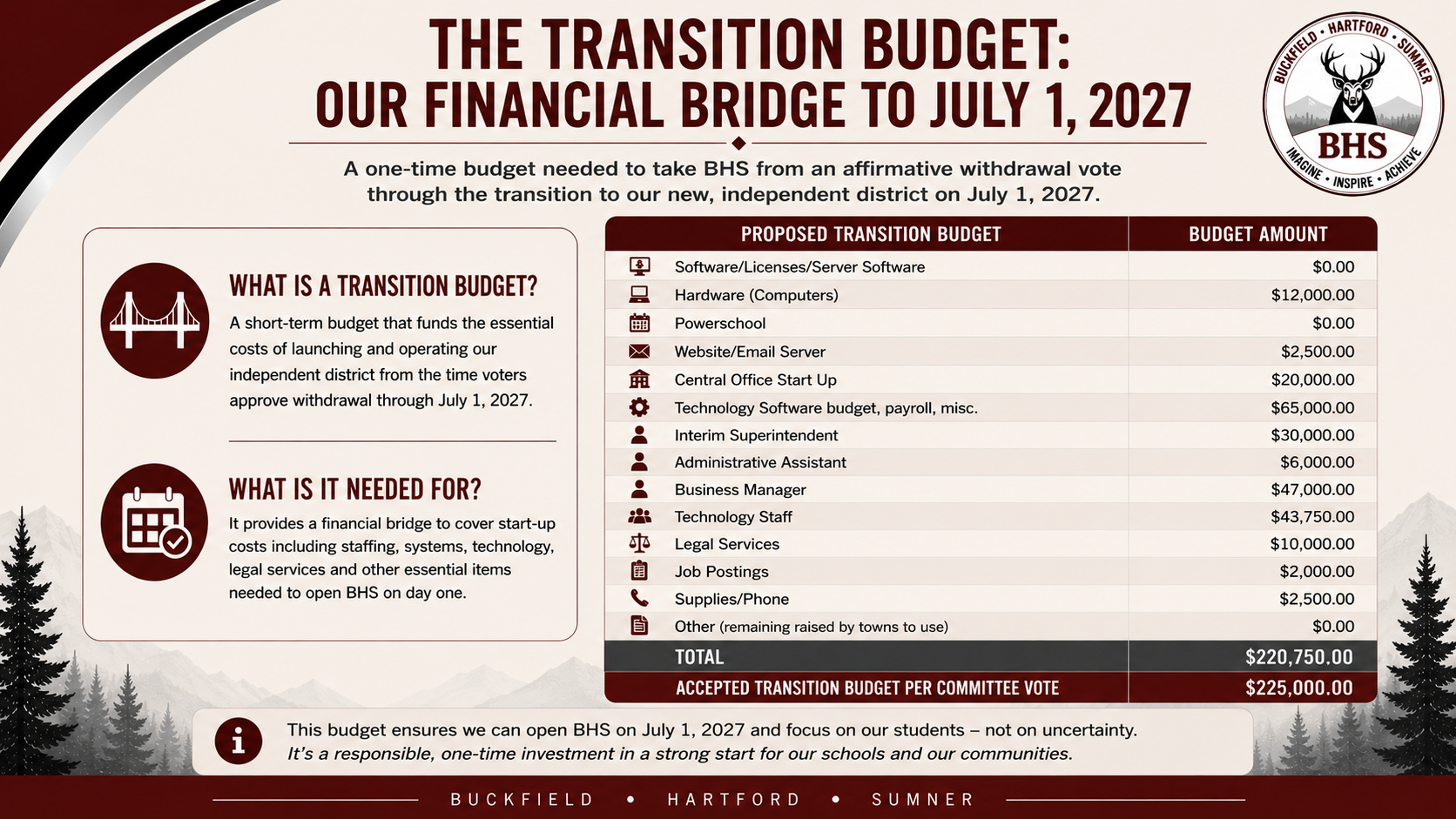
If withdrawal is approved, the new district cannot simply appear on July 1 fully operational. Work must occur between the referendum and the beginning of the new RSU.
The committee approved a $225,000 transition budget to provide the financial bridge necessary to establish the district.
It provides funding for items such as interim administration, business management, technology staffing and systems, computers, central-office startup costs, legal services, job postings, communications, and other organizational expenses required before the district begins operating.
7. How Could Withdrawal Affect Local Taxpayers?
Estimated Initial Tax Impact
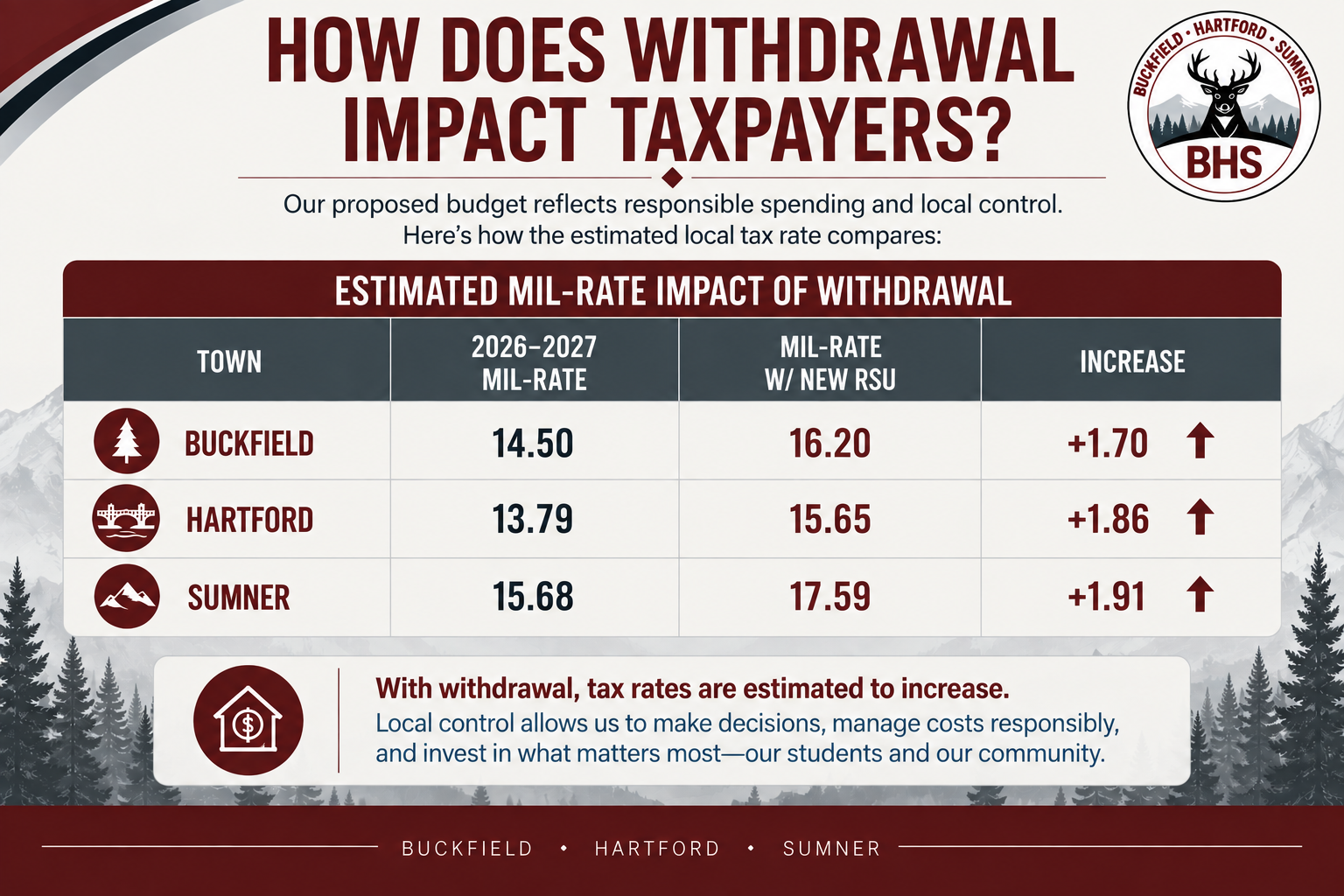
Based on the proposed operating budget and currently available valuation and funding information, these are estimates, not guaranteed future tax bills.** Actual municipal tax rates will depend on adopted budgets, state subsidy, property valuations, enrollment, municipal spending, and other factors.
Based on current estimates, the projected annual increase per $100,000 of taxable property value is approximately:
Buckfield: $170 per year
Hartford: $185 per year
Sumner: $191 per year
This allows property owners to estimate the potential impact using their own taxable assessment. For example, a property with $200,000 in taxable value would be approximately twice the amounts shown above.
Below, you can compare each community’s current mill rate with the projected mill rate under the proposed new BHS RSU budget, along with the resulting increase.
8. What Are BHS Communities Paying Today?
BHS Already Carries a Significant Share of RSU 10’s Local Costs
For FY2026–27, Buckfield, Hartford, and Sumner together are assessed approximately:
$5.19 million
That represents approximately:
32.8% of RSU 10’s total municipal assessments.
The FY27 increases are also significant:
Buckfield: +4.86%\ Hartford: +11.77%\ Sumner: +9.74%\ BHS combined: +8.35%
RSU 10’s overall local assessment increased approximately 4.13%.
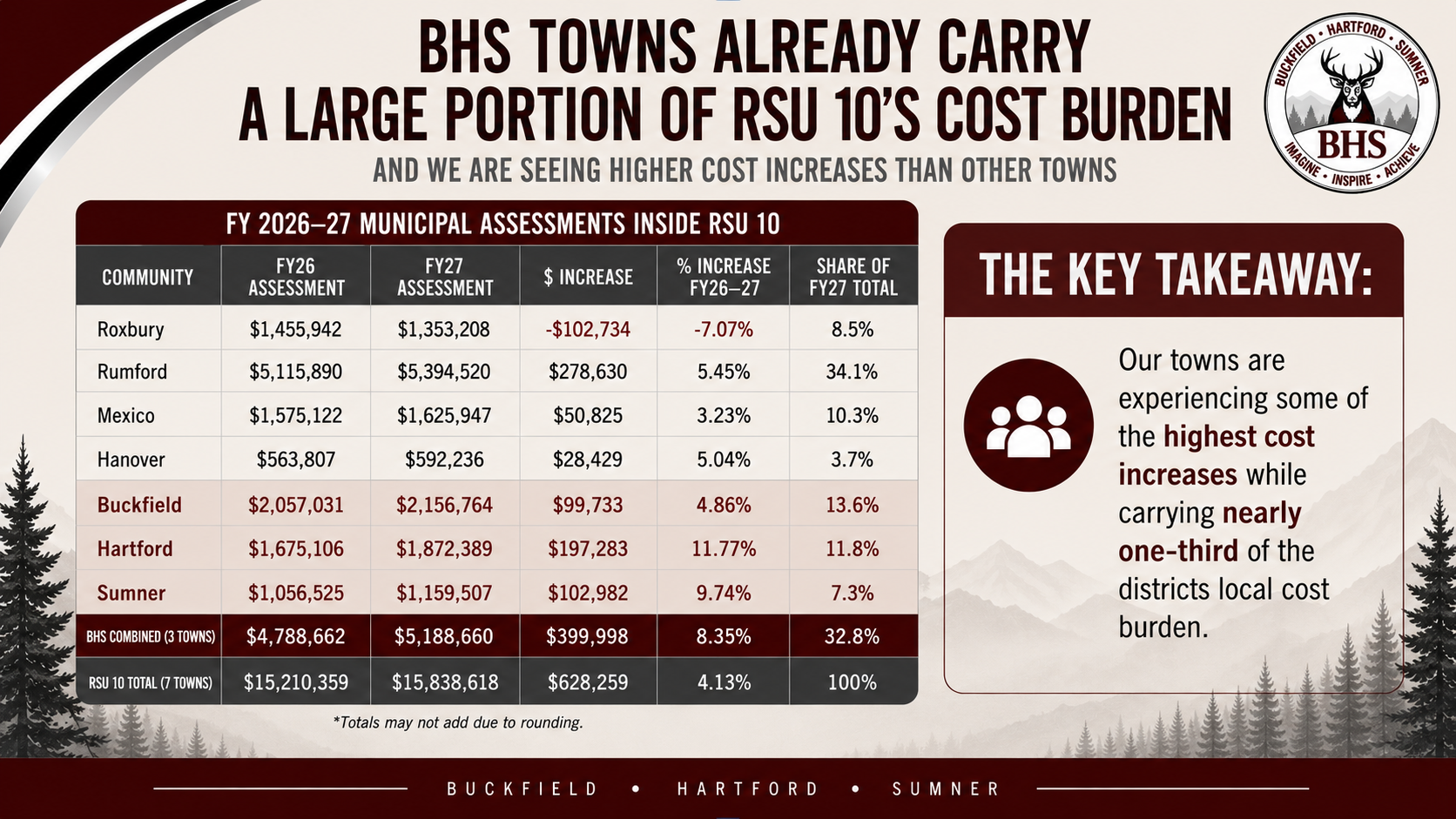
Our towns are experiencing some of the highest assessment increases while carrying nearly one-third of the district’s local cost burden.
9. What Has Happened to RSU 10’s Budget?
Ten Years of RSU 10 Budget Growth
RSU 10’s budget increased from approximately:
$27.73 million in FY2017–18
to
$45.05 million in FY2026–27
A total increase of approximately:
$17.32 million — 62.4%
Across that period, the compound annual growth rate is approximately:
5.54% per year.
RSU 10’s recent budget also includes state-subsidized major capital construction associated with MVCS. When that factor is removed, the calculated increase over the period is approximately 35.52%.
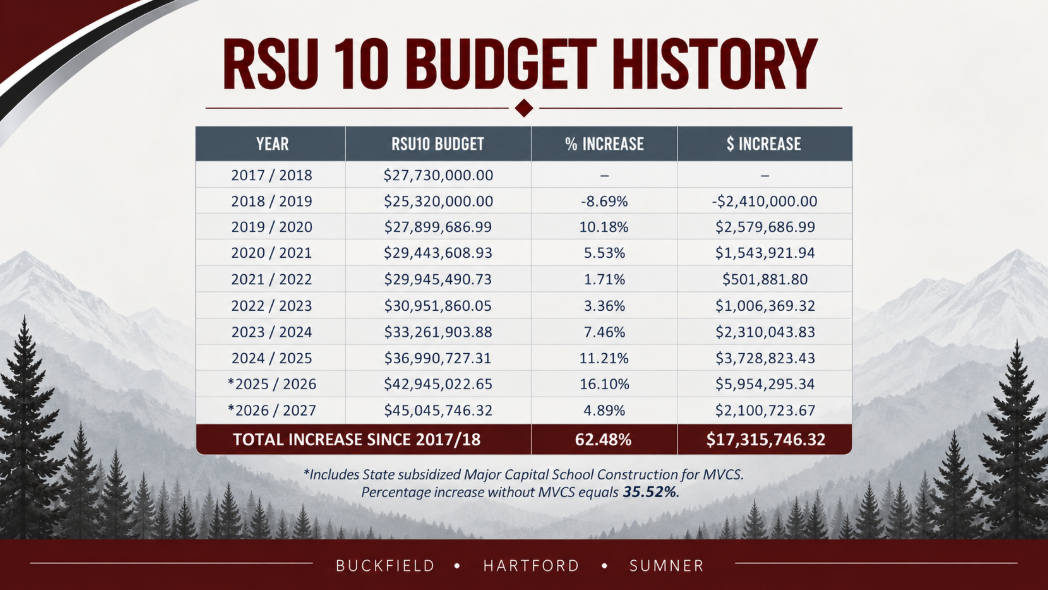
Growth will continue to occur regardless of district structure. The objective of a new BHS RSU would be to manage that growth responsibly and work to slow the rate of increase compared with what our communities have been experiencing.
10. What Can We Learn From Other Maine Communities?
Richmond
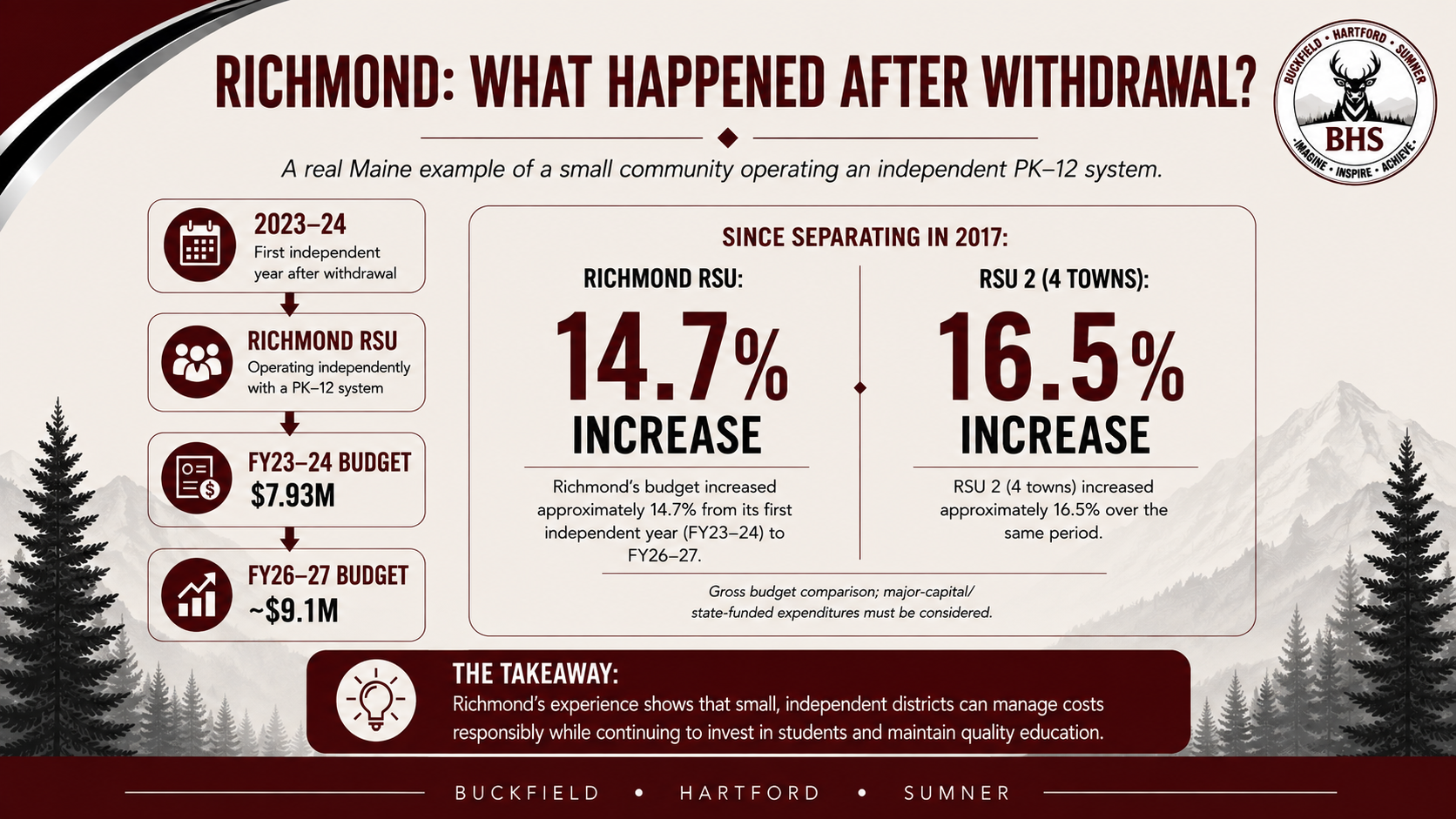
Richmond withdrew from RSU 2 and began operating independently in FY2023–24.
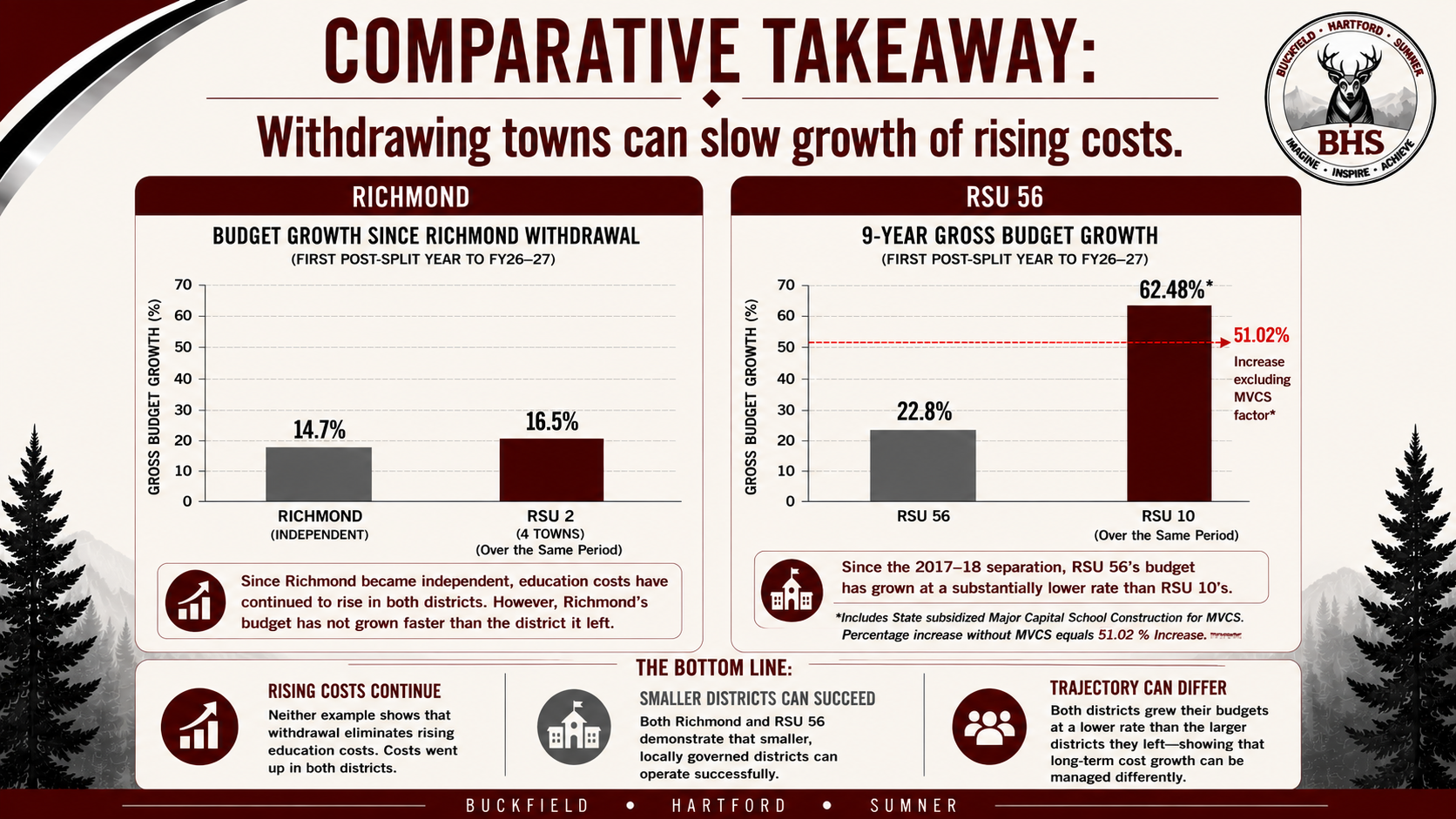
Richmond’s budget increased from approximately $7.93 million to $9.1 million, or approximately 14.7%.
Over the same general period, RSU 2 increased approximately 16.5%.
Takeaway
Costs continued to rise in both districts, but Richmond’s budget did not grow faster than the district it left.
RSU 56
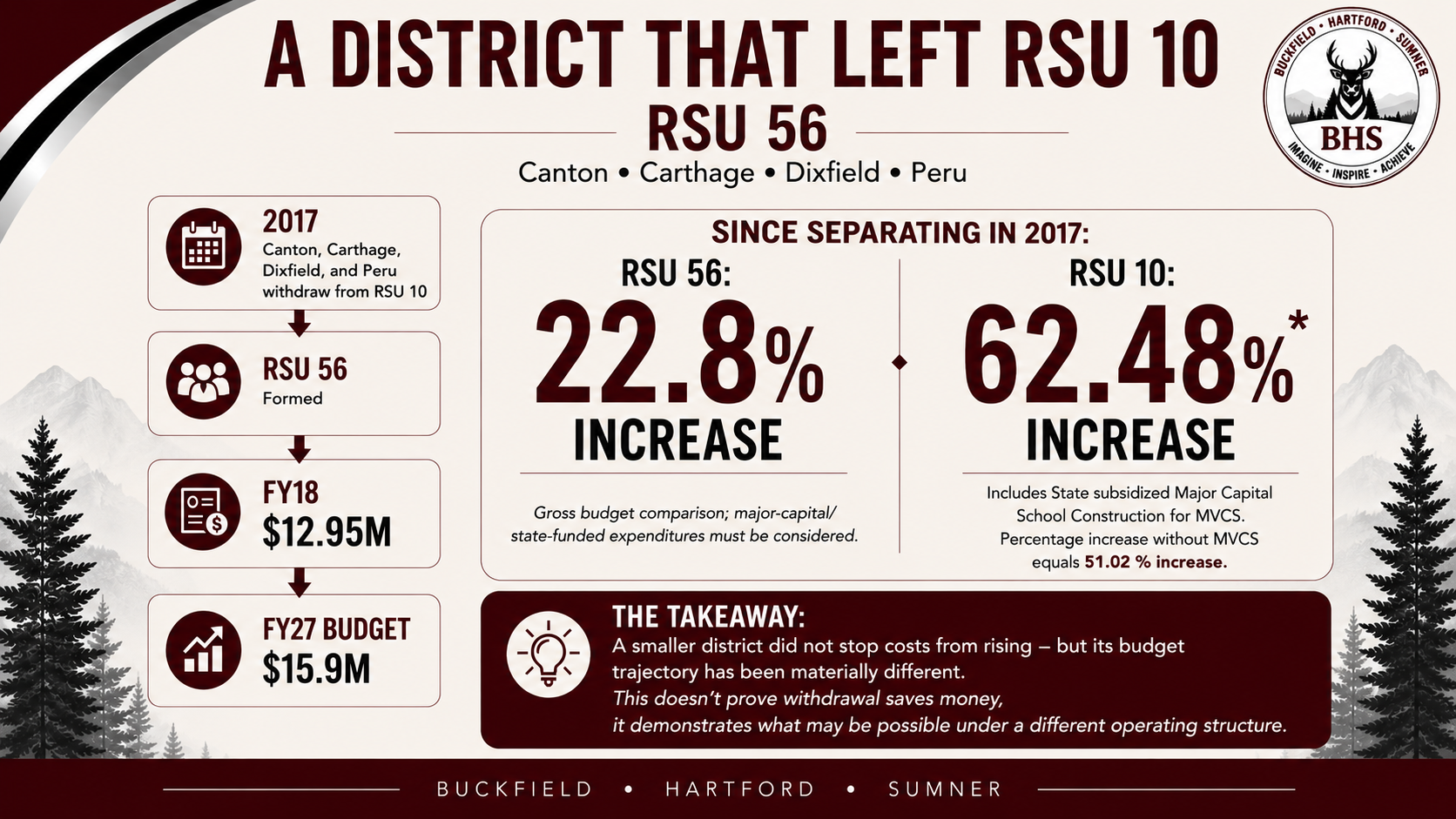
Canton, Carthage, Dixfield, and Peru separated from RSU 10 and formed RSU 56.
RSU 56’s budget increased from approximately $12.95 million in FY2017–18 to $15.9 million in FY2026–27, an increase of approximately:
22.8%
Over the same general period, RSU 10 increased approximately:
62.48%
or approximately 51.02% excluding the MVCS major-capital factor.
Takeaway
A smaller district did not stop costs from rising, but its budget trajectory has been controlled differently.
11. What Do These Comparisons Actually Tell Us?
They Do Not Guarantee Savings
Neither Richmond nor RSU 56 proves that withdrawal automatically saves money.
They demonstrate something narrower - and more useful:
Smaller Maine districts can successfully operate independently.
And:
Withdrawal does not necessarily cause education costs to grow faster than the larger district that was left.
RSU 56 also demonstrates that, under a different operating structure, long-term budget growth can occur at a materially different rate.
What That Means for BHS
The opportunity is greater local control over the decisions that drive future costs - not a guarantee that costs will decline.
12. Where Could Future Savings Come From?
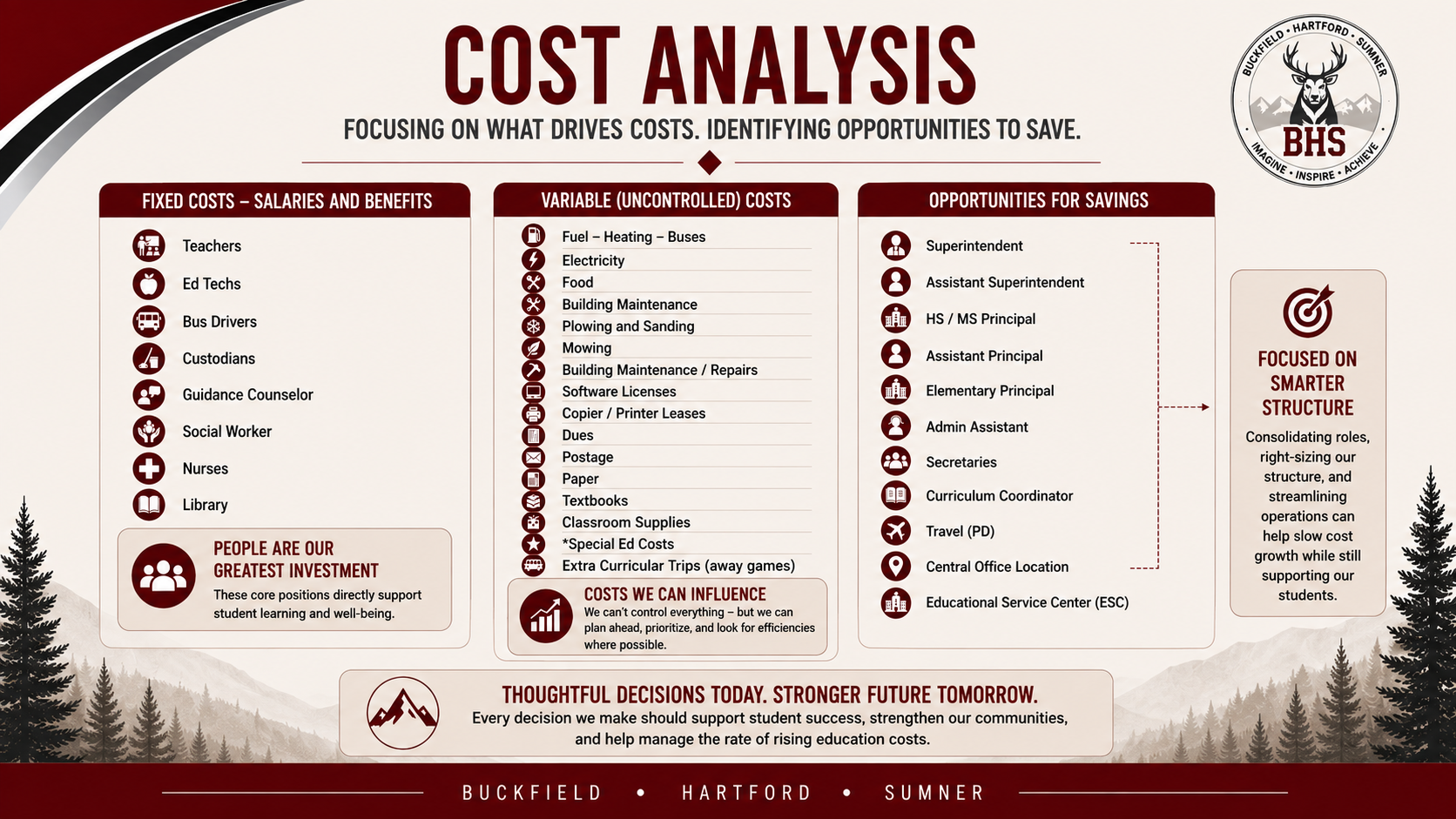
The committee did not build its proposed budget around eliminating student-facing programs or making broad staffing cuts.
Potential future efficiencies are more likely to be found through examining the structure of the district.
That could include administration, shared services, central-office functions, technology, purchasing, contracts, professional services, facilities planning, or combining responsibilities where appropriate.
Those decisions would ultimately belong to the future BHS School Board.
13. Educational Service Centers
A Resource & Cost Sharing Partnership
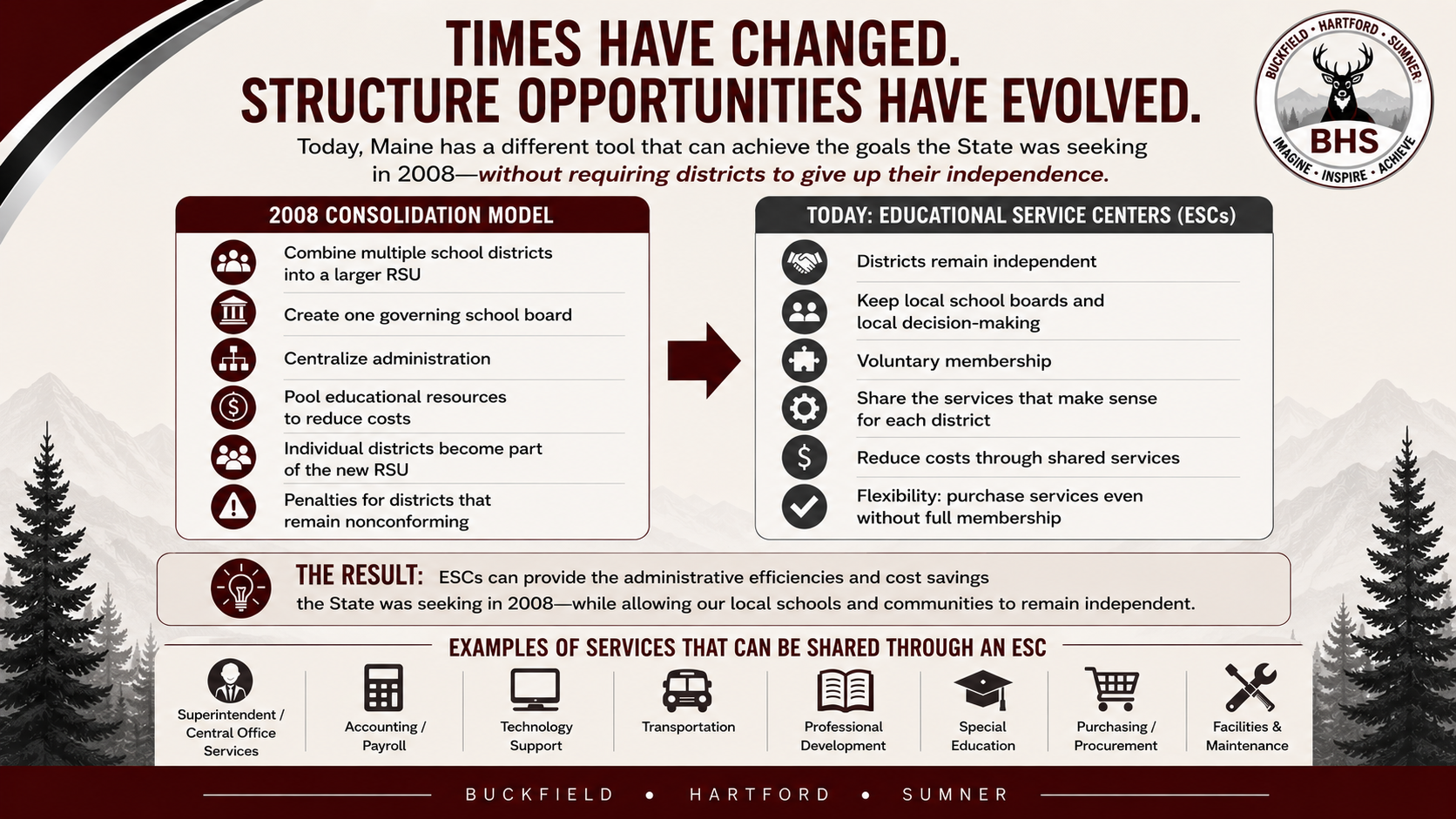
Educational Service Centers allow school districts to remain independently governed while voluntarily sharing services with other RSU’s where doing so makes operational or financial sense.
Potential shared services can include administration, accounting and payroll, technology, transportation, professional development, special education, purchasing, and facilities support.
The Important Difference
The consolidation model of 2008 generally sought efficiencies by combining districts into larger governance structures.
Educational Service Centers provide another option: To maintain local governance while sharing selected services where cooperation makes sense.
The BHS RSU Withdrawal and Reorganization Planning Committee is actively exploring Educational Service Center cost-sharing opportunities in preparation for a prospective New BHS District.
14. The New Maine DOE Funding Formula
Getting into the weeds…
Beginning with FY2028, Maine is changing how local ability to pay for education is calculated. The updated calculation considers:
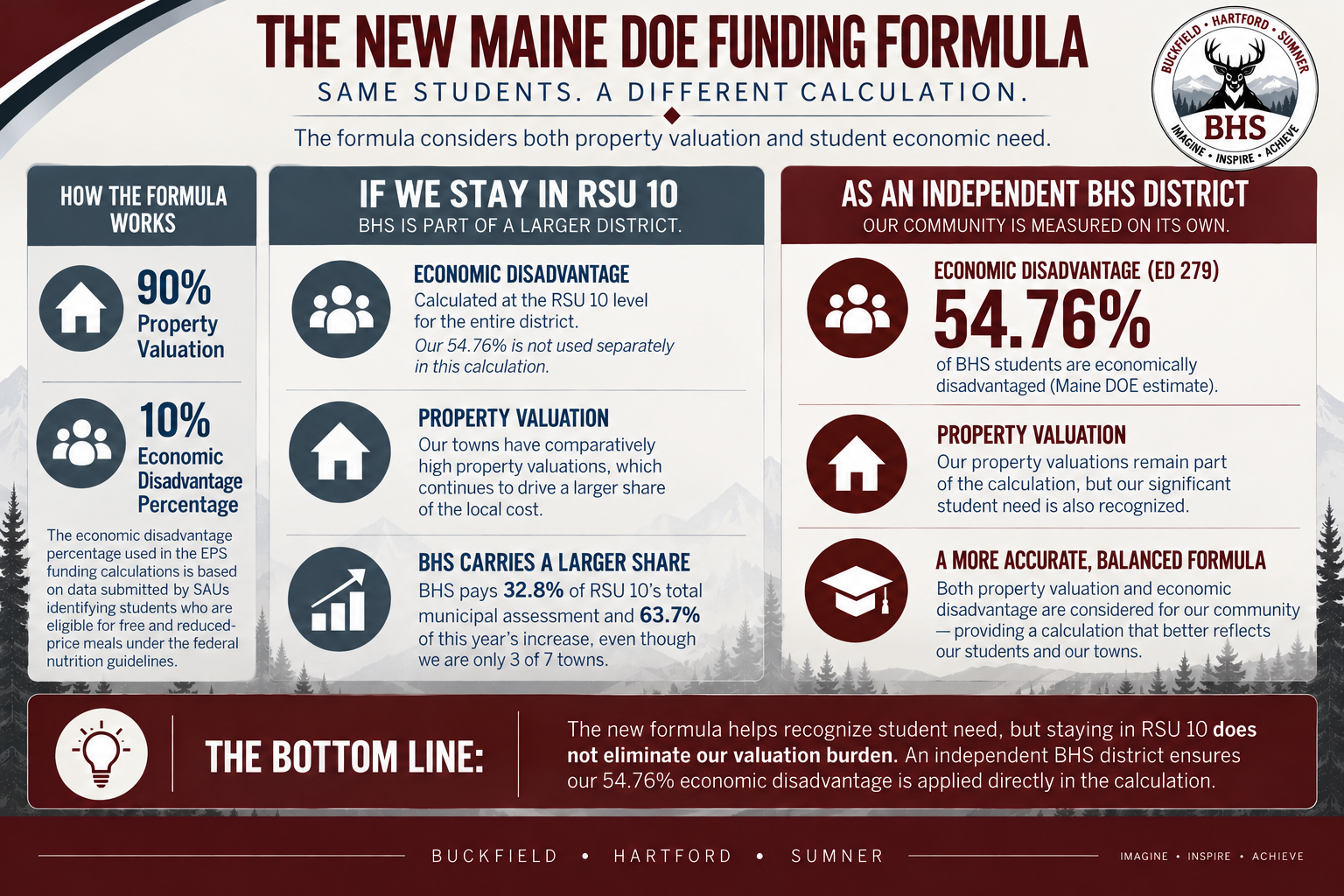
90% Property Valuation + 10% Economic Disadvantage
Property valuation remains the primary factor, but the new formula also recognizes the economic needs of students.
What does this mean for BHS?
As part of the withdrawal planning process, Maine DOE prepared an estimated ED279 for a proposed Buckfield–Hartford–Sumner RSU and calculated that:
54.76% of BHS students are economically disadvantaged… According to Maine DOE Director of Public School Finance, this is considered a high-poverty metric and would likely result in a lower required local mill rate for a BHS RSU under the updated formula.
Economic disadvantage is determined using information submitted by school administrative units identifying students eligible for free and reduced-price meals under federal nutrition guidelines.
Why district structure matters:
If BHS remains within RSU 10, the 54.76% BHS figure would not be used as a separate district-level percentage because BHS would remain part of the larger RSU 10 school administrative unit.
If a new BHS RSU is formed, Maine DOE would calculate funding for BHS as its own school administrative unit, considering both its property valuation and its student economic-disadvantage data.
The students and property values remain the same - but what changes is the school administrative unit through which those factors are calculated.
Withdrawal is projected to require a higher initial local contribution although, remaining in RSU 10 means continuing to participate in a district whose budget and local assessments have experienced substantial growth over the period examined.
Greater local authority does not guarantee lower costs. However, Maine’s new funding formula and opportunities to share resources through an Educational Service Center could provide BHS with additional tools to manage future cost growth.
The question for each voter is ultimately whether the proposed structure, financial commitment, governance model, and opportunity for greater local control represent the best path forward for Buckfield, Hartford, Sumner, and their students.
15. What Would Local Control Actually Mean?
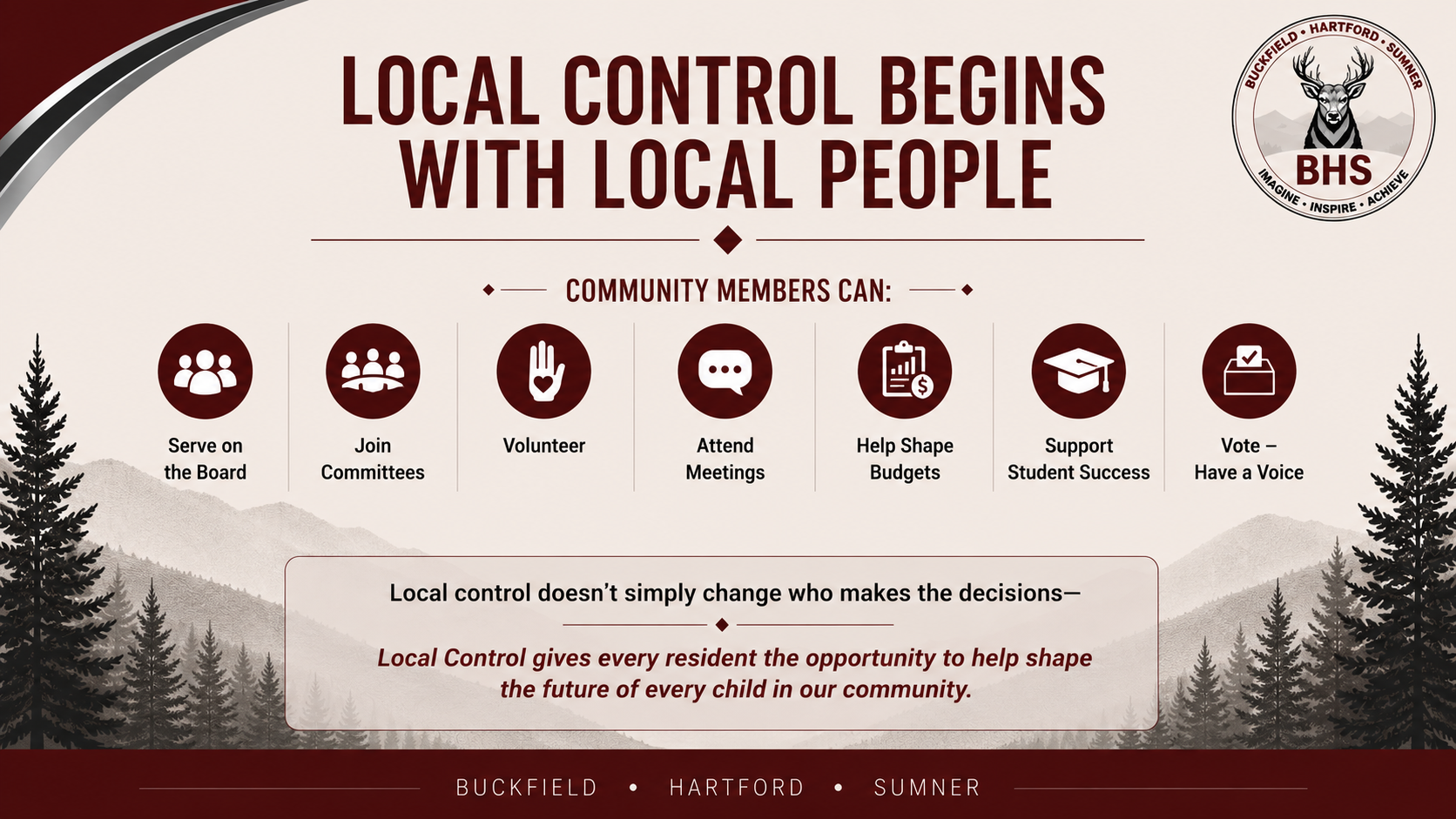
If the new district is formed, Buckfield, Hartford, and Sumner would elect the board responsible for governing the BHS RSU.
That board would make decisions involving:
Budget Priorities • Administration • Staffing • Programs • Facilities • Transportation • Contracts • Capital Planning
Local control does not eliminate state requirements, education standards, special-education obligations, labor agreements, inflation, or other costs.
It changes who is responsible for making many of the decisions with those requirements.
16. Misconceptions / Misinformation
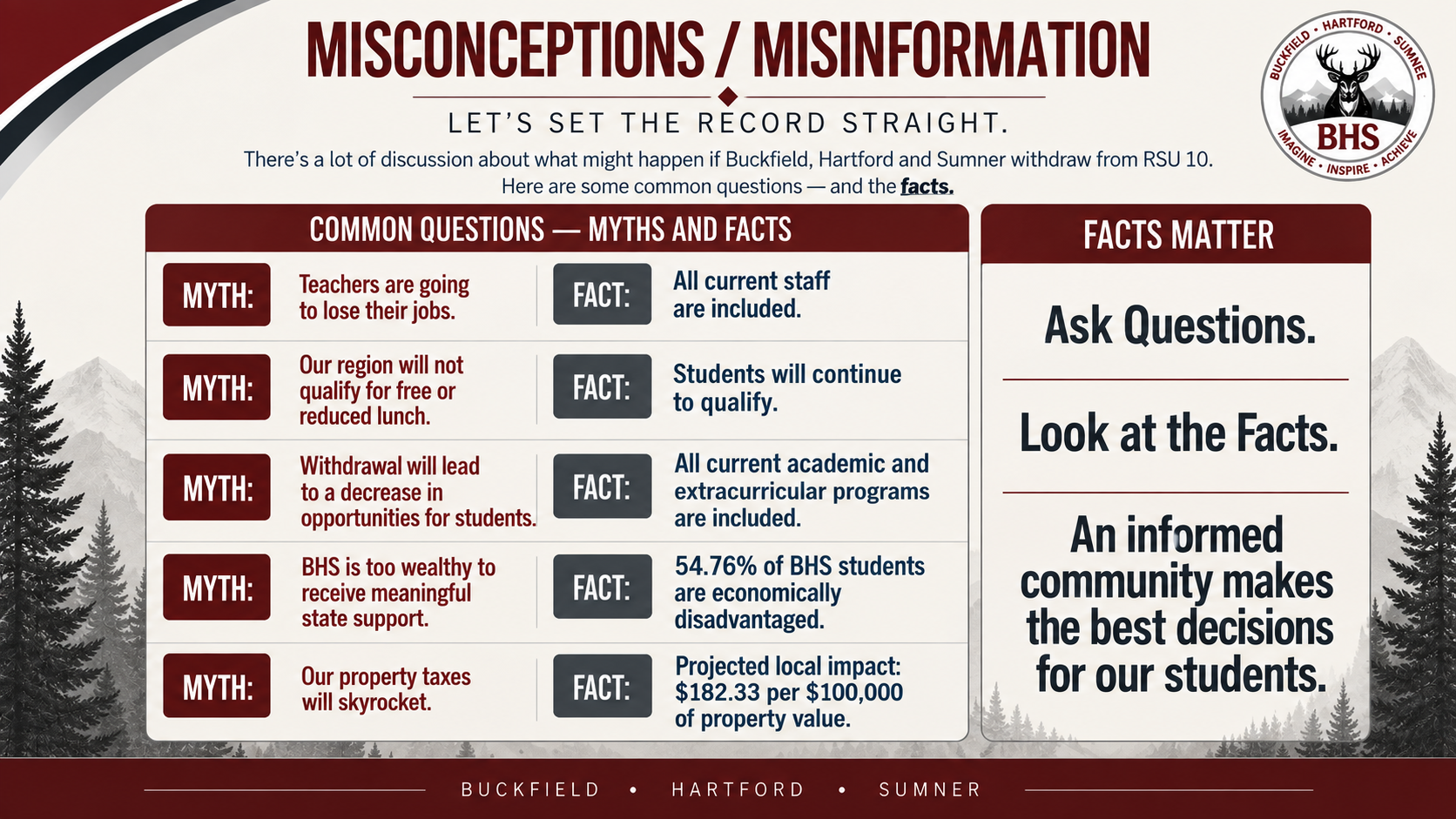
As the November 3 referendum approaches, residents have raised important questions about what withdrawal could mean for students, staff, programs, state funding, and local taxes.
With an issue this significant, it is important that our decisions are based on verified information - not assumptions, rumors, or incomplete information.
We encourage every voter to ask questions, review the data, and look closely at the facts developed throughout this process. Below are several of the most common concerns the committee has heard, along with supportive information to respond to those concerns:
17. The Decision Before Voters
Overall Summary of Data
Remaining in RSU 10 means continuing to participate in the district as we do now - nothing changes other than year to year costs and/or decisions made by future school boards.
A new BHS RSU would provide greater local authority over future educational and financial decisions, but withdrawal alone does not guarantee lower costs.
As its own school administrative unit, BHS would have Maine’s new funding calculation applied to its own property valuation and economic-disadvantage data. Maine DOE has estimated BHS’s economic-disadvantage rate at 54.76%, which DOE’s Director of Public School Finance indicated would likely result in a lower required local mill rate under the new formula. The statewide change uses 90% property valuation and 10% economic disadvantage in determining the required local mill rate.
At the same time, becoming a smaller district means some services currently shared across RSU 10 would need to be provided differently. One option would be for BHS to create or join an Educational Service Center (ESC), allowing BHS to share selected services and resources with other school districts while maintaining its own school board and local governance. Maine DOE specifically identifies ESCs as a way for districts to operate more efficiently and economically and provide services that might otherwise be cost-prohibitive.
Together, the new funding formula and strategic use of shared services could provide a new BHS RSU with tools to manage future cost growth while preserving local decision-making and educational opportunities for students. Future opportunities and cost savings through an ESC are not guaranteed. Further exploration of starting or joining an existing ESC would be a duty of the school board under a new RSU.
The question for each voter is ultimately whether the proposed structure, financial commitment, governance model, and opportunity for greater local control represent the best path forward for Buckfield, Hartford, Sumner, and their students.
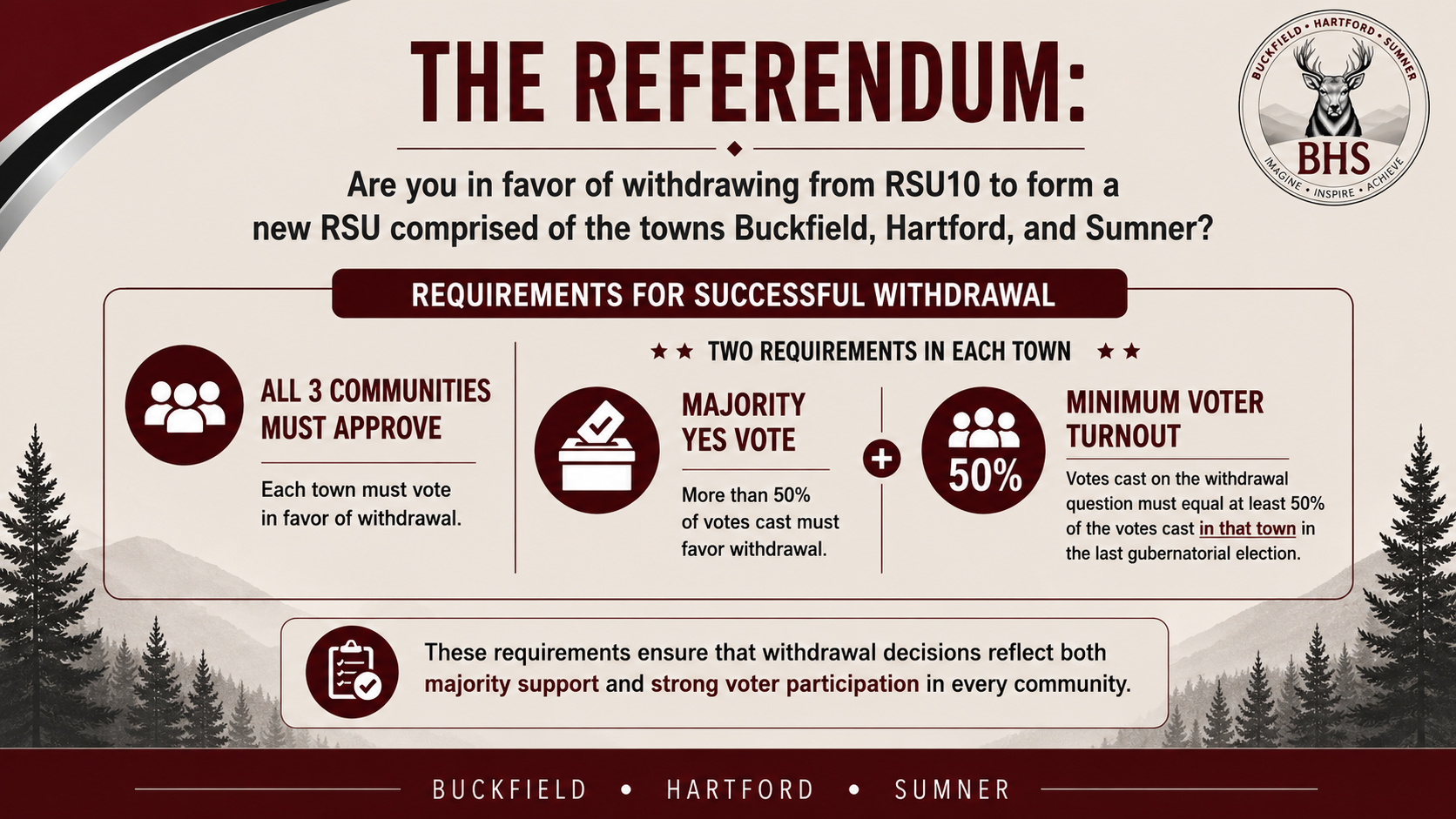
Referendum: November 3, 2026
Below are the factors that would need to be fulfilled for withdrawal to take place and for the formation of a New BHS District:
18. Whats Next?
If the Referendum Passes
If voters approve withdrawal on November 3, 2026, the focus shifts from planning to implementation.
The months between the referendum and July 1, 2027 provide the transition period needed to establish the new BHS RSU and prepare it to begin operations.
A successful referendum does not mean an immediate change to our schools. It begins a planned transition period designed to maintain continuity for students and staff while the new district is established.
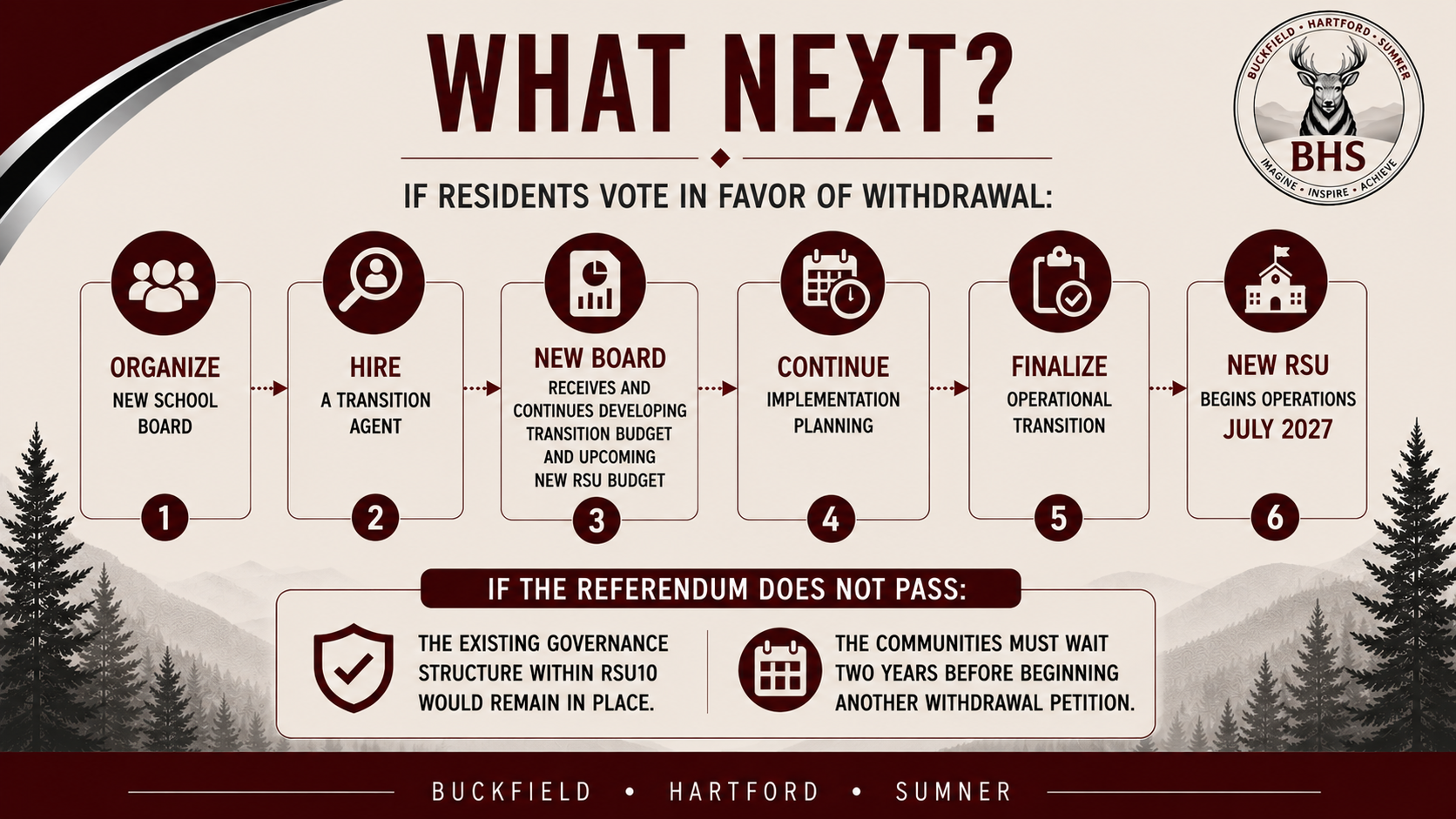
The committee’s planning work provides the framework for that transition; after voter approval, responsibility for governing the new district will transition to the newly elected BHS School Board.
Committee Links:
Click HERE to access our Google Drive
Email us at: bhswithdrawalcommittee@gmail.com
Generated by the BHS RSU Withdrawal and Reorganization Planning Committee